North Channel vs Georgian Bay: Comparing Two Great Lakes Cruising Grounds
If you are planning a cruising trip on the upper Great Lakes, two areas come up in almost every conversation: Georgian Bay and the North Channel. They share the same general geography, connected by water at Killarney and the passages around Manitoulin Island. But the cruising experience in each is distinct enough that choosing between them, or deciding how to split your time, is one of the most important planning decisions you will make. This is a straightforward comparison of the two, based on what matters to boaters.
Geography and Character
Georgian Bay is the eastern arm of Lake Huron, bounded by the Ontario mainland and the Bruce Peninsula. Its eastern shore is lined with the 30,000 Islands, a vast archipelago of granite and pine stretching from Severn Sound to the French River. The western shore is more open, with deeper water and fewer islands. The bay is large enough to generate its own weather and has a full range of harbour towns along both coasts.
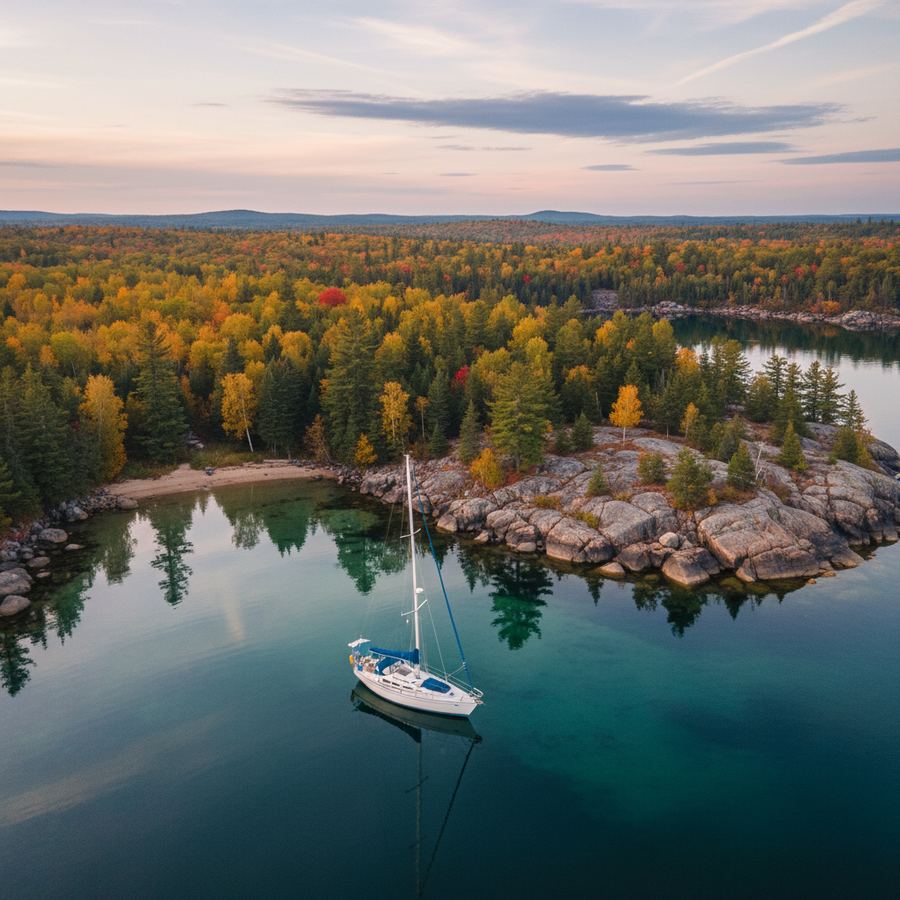
The North Channel runs between the north shore of Manitoulin Island and the mainland of northern Ontario, from Killarney east to Thessalon and the St. Marys River west. The landscape is Canadian Shield at its most dramatic: white quartzite cliffs, deep clear lakes, and forests that have not been logged in a century. The North Channel is narrower than Georgian Bay, but the scenery is bigger.
Remoteness
This is the most significant difference between the two cruising grounds. Georgian Bay has more people, more boats, more marinas, and more towns. You are rarely more than a few hours from a harbour with fuel and groceries, and cell service covers most of the inner islands. The 30,000 Islands can feel wild, but civilization is usually within reach.
The North Channel is genuinely remote. Once you pass Killarney heading west, the towns thin out quickly. Little Current on Manitoulin is a real town with services. Beyond that, you have a handful of small harbours and government docks, but stretches of 30 or 40 nautical miles with nothing but rock and water are normal. Cell service is unreliable to nonexistent. If something goes wrong, you are solving it yourself or calling on VHF.
For some cruisers, that remoteness is exactly the point. For others, particularly those with less experience or families with young children, it is a reason to think carefully about preparation and contingency plans.
Navigation
Georgian Bay's 30,000 Islands have a marked small craft route that threads through the inner channels and connects the major ports. The route is buoyed and charted, and while it still requires attention, it offers a relatively protected corridor. Outside the marked route, the islands present typical archipelago navigation: unmarked shoals, tight passages, and depths that change without warning. A good chartplotter and up-to-date CHS charts are essential.
The North Channel has fewer navigational aids and fewer boats, which means fewer eyes on the hazards. The Benjamin Islands, the Whalesback Channel, and the entrance to the various anchorages along the north shore all require careful piloting. Many of the best anchorages involve nosing into a gap between islands or running a narrow passage between rock walls, which is thrilling and beautiful but not something to attempt if you are tired, rushed, or unfamiliar with the boat.
Both areas reward preparation. Read the cruising guides before you go, not while you are underway. Plot your route in advance. And carry paper charts as a backup, because electronic systems can fail at exactly the wrong moment.
Services and Provisioning
Georgian Bay wins on services, and it is not close. Penetanguishene, Midland, Parry Sound, and Owen Sound are all substantial towns with full grocery stores, marine services, fuel docks, restaurants, and medical facilities. Even the smaller stops like Tobermory and Killarney have enough to cover basic needs. You can cruise Georgian Bay for two weeks and never worry about running out of anything.
On the North Channel, provisioning requires planning. Little Current is the best-stocked town on the route, with a good grocery store, marine supply, and several restaurants. Gore Bay and Blind River have smaller stores. Beyond those, you are relying on whatever the local general store stocks, which may not be much. Carry enough food and fuel for longer stretches between supply points, and do not assume that every government dock will have water or power.
Traffic and Crowding
Georgian Bay is busier. The 30,000 Islands attract a large number of recreational boaters, cottagers, fishing boats, and tour boats, especially in July and August. Popular anchorages fill up on weekends, and the marked channels can feel like highways at peak times. If you head to the outer islands or cruise midweek, you will find more space, but Georgian Bay in high summer is not a wilderness experience.
The North Channel is one of the least crowded cruising grounds in North America. You will see other boats, particularly in the well-known anchorages like the Benjamin Islands, but it is entirely normal to spend a night in an anchorage and see nobody else. The sense of solitude is real and sustained, and it is one of the main reasons people make the trip.
Weather
Both areas share the basic Great Lakes weather pattern: summer thunderstorms that build fast, prevailing westerlies, and occasional sustained heavy weather that can pin you in harbour for a day or two. Georgian Bay's open-water sections build serious waves in strong winds, and the funneling effect through the islands creates localized gusts. The North Channel is more sheltered by the surrounding landmass, but narrow enough that the wind shifts direction as it wraps around headlands.
In either area, check the marine forecast every morning and be willing to stay put if the weather does not look right. A comfortable harbour day with a book and a good meal ashore is always better than a rough passage you did not need to make.
Which One Is Right for You
If you are a first-time Great Lakes cruiser, or if your crew includes people who are new to boating, Georgian Bay is the better starting point. The services are closer, the navigation is more forgiving, and the harbour towns give you regular opportunities to step ashore and break up the passage. You can build experience in the 30,000 Islands and still have a memorable trip without pushing into truly remote water.
If you have solid cruising experience, a well-equipped boat, and a crew that is comfortable with self-reliance, the North Channel is hard to beat. The scenery is world-class, the solitude is genuine, and the challenge of navigating unfamiliar waters in a remote setting is deeply satisfying when it goes well. Many experienced Great Lakes cruisers consider the North Channel the best cruising anywhere in freshwater.
The good news is that you do not have to choose permanently. A two-week trip can include both areas, entering Georgian Bay from the south, running north to Killarney, crossing into the North Channel, and returning via Manitoulin. That loop is one of the classic Great Lakes routes, and it gives you a taste of everything the region offers.