Harbour Etiquette and Marina Basics
Harbours and marinas have rules, some posted and some not. The posted ones cover the obvious: speed limits in the harbour, pumpout requirements, quiet hours. The unwritten ones are what trip up new boaters. Get them wrong and you won't get a lecture, but you'll get looks. Get them really wrong and you'll damage boats or make enemies in a community that has long memories.
If you're new to cruising or chartering on the Great Lakes, here's what you need to know before pulling into your first marina.
Approaching and Entering a Harbour
Slow down before you enter the harbour. Not when you see the breakwall. Before. Most harbours have a speed limit of 4 or 5 knots inside the breakwater, but your wake reaches the docked boats before you do. A 10-knot approach that slows to 5 at the entrance still sends a rolling wake through the basin that rocks every boat in it and bangs them against the dock. Cut your speed well outside the entrance.
If you're under sail, drop your sails before entering the harbour and motor in. Sailing into a crowded marina is not a display of skill. It's reckless. There's no room to manoeuvre if something goes wrong, and the boats on either side of your assigned slip didn't sign up for the show.
Call the marina on VHF channel 68 as you approach. Identify yourself, give your boat length, and ask for slip assignment. They'll tell you where to go and sometimes send someone to help you dock.
Docking
Have your lines and fenders ready before you reach the slip. This is not something to figure out as you're coasting in. Bow line, stern line, and two spring lines should be coiled and accessible. Fenders should be hung at dock height on the side you'll be tying up on.
If you're coming alongside a dock (rather than into a slip), approach slowly at a shallow angle, get the bow line on first, then use it as a pivot to bring the stern in. In wind or current, the approach changes, but the principle holds: get one line on the dock and work from there.
The most common mistake new boaters make is coming in too fast. Boats don't have brakes. A 10,000-pound sailboat moving at 2 knots hits a dock with real force. If in doubt, make your approach, and if it's not working, back out and try again. Nobody judges a second attempt. Everybody notices a collision.
Lines and Cleats
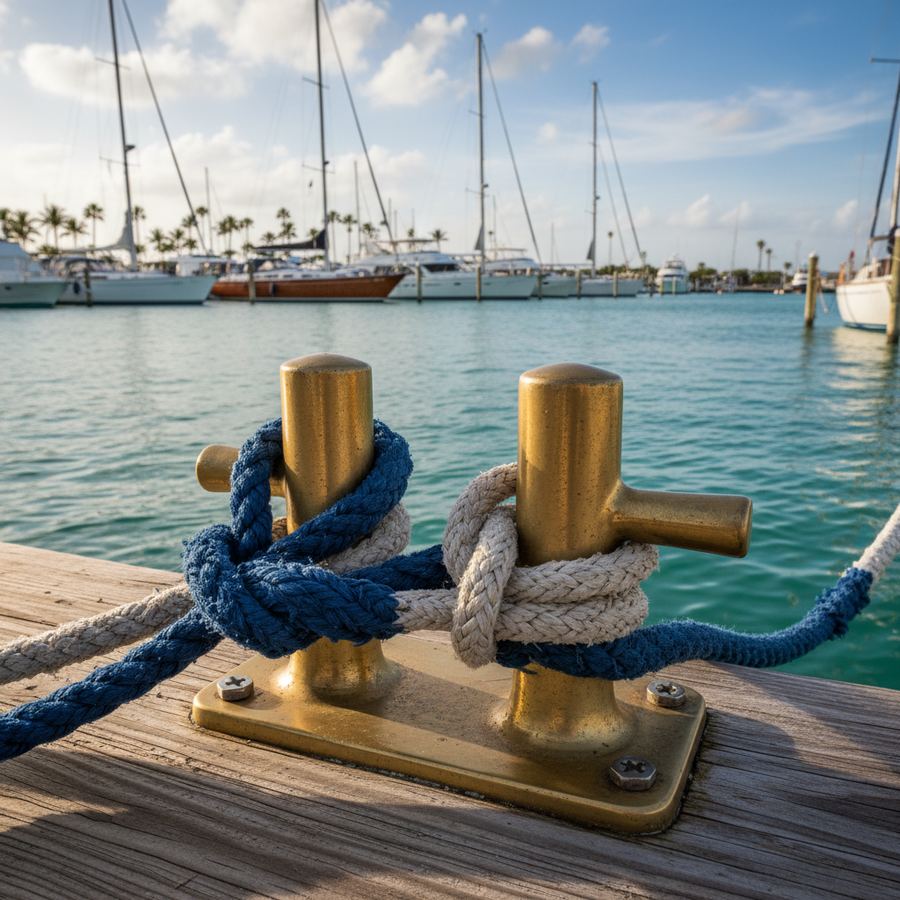
Tie your lines properly. A cleat hitch is the standard: one full turn around the base, then figure eights, finished with an underhand loop that locks it. Don't just wrap the line around the cleat a dozen times. It looks sloppy, it's hard to release in an emergency, and it damages the line.
Use your own cleats, not your neighbour's. Every boat has dock cleats assigned to its slip. If there's any ambiguity, ask the dockmaster. Tying your line to someone else's cleat means they can't adjust their own lines without untying yours first, which is a guaranteed way to irritate the boat next door.
Leave slack in your lines for tide and water level changes. On the Great Lakes, you don't get ocean tides, but water levels do shift with wind and barometric pressure. Georgian Bay can see water level fluctuations of a foot or more during strong wind events. Lines that are bar-tight in the evening can be pulling cleats out of the dock by morning.
Rafting
Rafting is when multiple boats tie up side by side, with only the innermost boat on the dock. It's common in busy harbours. If someone asks to raft alongside you, the convention is to agree unless you have a good reason not to. Use fenders generously between the boats and run your own lines to the dock if possible.
When rafted, you'll need to cross other boats to reach the dock. Step on the gunwale or deck, never on cabin tops or hatches. Be quick and quiet, especially early and late in the day, and always ask permission the first time.
Shore Power
Most marinas offer 30-amp shore power. Plug in with your own cord (the charter boat should have one aboard) and check that it's in good condition before connecting. A bad connection can trip breakers for the entire dock. Be reasonable about your draw. Running air conditioning, a heater, and a microwave simultaneously will trip the breaker and annoy your dock neighbours.
Pumpout
In Ontario, discharging sewage overboard is illegal in all inland waters. Your holding tank must be emptied at a pumpout station, available at most marinas. This is non-negotiable and not optional. Transport Canada and provincial regulations are clear on this.
Know where pumpout stations are along your route and use them before the tank is full. When using a pumpout, follow the posted instructions and secure the nozzle firmly before turning on the pump. Rinse the area when you're done.
Quiet Hours and General Courtesy
Most marinas enforce quiet hours from 10 PM or 11 PM to 7 AM. This means no music, no loud conversation on deck, no running generators, and no halyards slapping against the mast. That last one is a specific pet peeve of every liveaboard and long-term slip holder. If your halyards are clanking, tension them. Tie them off to a shroud or use a bungee to pull them away from the mast. The sound carries across the entire marina and it goes on all night.
During daylight hours, keep music at a reasonable volume. Your taste in music is not shared by everyone within 50 metres. Sound travels extraordinarily well over water.
Dispose of garbage properly in the marina's designated bins. Don't leave bags on the dock. Don't dump food scraps or dishwater overboard in the harbour. Use the marina washrooms and showers, and leave them as you found them.
What New Boaters Get Wrong
A few specific things that mark someone as new, and how to avoid them:
- Approaching too fast. The number one issue. Slow means slow.
- Not having lines ready. The scramble to find lines while drifting toward a dock is stressful for everyone.
- Walking on other boats without asking. Even in a raft, ask first.
- Using too much water. Marina water is shared. Don't run a hose for 30 minutes to wash your deck.
- Blocking the fuel dock. Fuel up and move. Don't tie up there to go have lunch in town.
- Ignoring the dockmaster. They assign slips and manage the harbour. Listen to them.
None of this is complicated. The core principle is simple: be considerate of the people and boats around you, follow the rules, and leave things better than you found them. Harbours work because most boaters hold up their end of the arrangement.
If you're new to chartering, our guide to what a Great Lakes charter involves covers the broader picture. For route planning and knowing which harbour towns to include on your itinerary, start with the trip planning guide.